
Sohan Halwa is a chewy, sticky, buttery sweet made from milk, sugar, wheat or corn flour, and pure ghee, slow-cooked for hours and topped with nuts like almonds and pistachios.
If you have ever eaten a piece of Sohan Halwa, you know how good it feels. It is chewy, a little sticky, and it seems to melt in your mouth. But what is really inside it? It is not hard to explain. It is just a few simple foods, cooked the slow and careful way. This dessert, or traditional sweet, has been made the same way for a very long time.
A Sweet With Roots in Persia and the Mughal Era
The word sohan did not start in Pakistan or India. Most word history, or etymology, says it came from Persia, so people call this a Persian origin word. It may come from the Sanskrit word shobhan, which means beautiful or pleasant. A man named John Thompson Platts wrote about this in his old book, the Dictionary of Urdu Classical and English. This shows a link between Urdu and older languages. If you want to say the word out loud the right way, the IPA pronunciation is ˈsoːɦən ˈɦəlʋaː.
Nobody knows the full history of this sweet for sure. The oldest recorded story is highly debated, which means people do not agree on it. Some say it started in the Mughal era, during the time of the Mughal Emperor Shah Alam II. Other stories say it began in Old Delhi, at a shop called Ghantewala in the year 1790. Some people talk about a man named Diwan Sawan Mal Chopra, who was the Governor of Multan in the 19th century. Others say a confectioner, or sweet maker, named Sohan Lal gave it his name. Nobody can prove which story is true. But that is part of what makes this South Asian dessert so fun to learn about.
How Multan Turned It Into Its Own Food Identity
Cities like Delhi, Ajmer, and even Qom in Iran make their own kind of saffron brittle sweet too. But it is the city of Multan that made this sweet famous. In Pakistani cuisine, and more so in Saraiki cuisine and Mughlai cuisine, people treat Multani Sohan Halwa like a symbol of their city. Families do not just eat it at home. It is a cherished gift during Eid, at weddings, and when family comes to visit.
This sweet is a popular attraction across the whole subcontinent. People now ship it far past Pakistan, all the way to the Middle East, the United States, and the United Kingdom. Many specialty food stores now sell it to people who miss the taste of home.
The Core Ingredients Behind the Rich, Buttery Flavor
The core ingredients are easy to find. The hard part is knowing how to cook them right. A good batch uses:
| Ingredient | What It Does |
|---|---|
| Whole milk or full-fat milk | Gives it a creamy base |
| Sugar | Adds sweetness and helps with caramelization |
| Water | Used to thin the mix at the start |
| Wheat flour or cornflour (sometimes sprouted wheat flour, called Anguri) | Builds the thick, chewy body |
| Pure desi ghee (also called clarified butter) | Adds a rich, buttery flavor |
| Saffron, cardamom (also called Illaichi), and kewra | Add smell and distinctive flavor |
| Dry fruits: almonds (Badam), pistachios (Pista), walnuts (Akhrot), cashews (Kaju) | Add crunch and flavor on top |
Some shops use plain refined flour, called Maida. But many good shops use sprouted wheat instead. They believe it makes the halwa taste better and gives it a stronger nutty aroma once it is cooked.
The Slow-Cooked Process That Builds the Texture
Making Sohan Halwa takes real work. There is no fast way to do it. First, the flour and water are mixed so there are no lumps. Then it is heated on medium-low heat. Milk is added, and the water slowly cooks away. This step is called liquid reduction. Then sugar is added. Last, the ghee is poured in, a little at a time, until the mix turns smooth and rich.
One person has to stand and stir the whole time. This is called continuous stirring, and it can take 2 or more hours. Stirring stops the mix from sticking to the pan and helps it build its thick, dense feel. Many shops still use old copper pots and wooden paddles to stir by hand, just like their grandparents did. Old cooks use a string test to check if it is almost ready. If they stop stirring too soon, or let it burn, the whole batch is ruined. So good timing matters a lot.
When the color turns deep golden brown, and the mix pulls away from the sides of the pan, it is done. It gets poured onto flat trays to cool. Then it turns into its final shiny, glassy texture.
Why the Texture Feels So Different From Other Sweets
Sohan Halwa is not soft like most halwa. It has a chewy-brittle texture. That means it snaps a little when it is cold, but softens in your mouth as you eat it. A good piece looks shiny, almost see-through, which is called a translucent sheen. The nuts should not just sit on top. They should be spread all through the piece. That is one easy way to tell if a piece is made the right way.
It is usually cut into small square pieces or round discs about 5 to 6 millimeters thick. Then it gets topped with nuts. Old shops still like to pack it in fancy metal tin cylinders. Many shops now also use new gift boxes, so it travels well when people send it far away.
Multani Sohan Halwa vs DI Khan Halwa
People often compare Multani halwa to DI Khan Halwa, which comes from a nearby area. Multani halwa usually feels more chewy. DI Khan halwa is usually more crispy. Neither one is better. It just depends on what a person likes, and how the family that made it chose to cook and stir it.
How Hafiz Wadood Halwa Keeps This Craft Alive
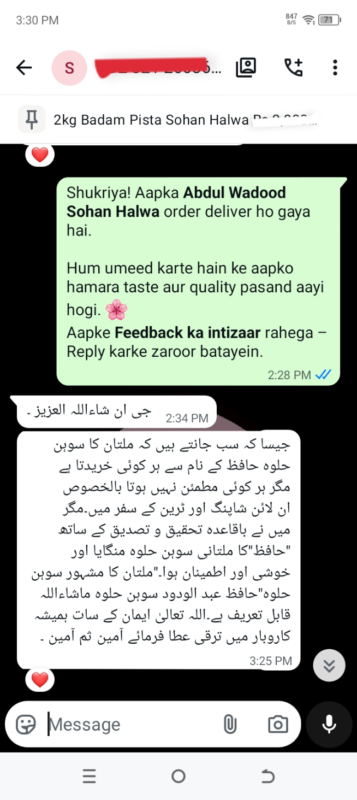
At Hafiz Wadood Halwa, the rule is simple: no shortcuts. That means real pure desi ghee, never cheap oil. Every batch still uses the same classic recipe and old methods passed down through the family for many years.
Here are the halwa flavors made at the shop:
| Product | What Makes It Special |
|---|---|
| Badam Pista Sohan Halwa | Almonds and pistachios in every bite |
| Akhroti Pista Sohan Halwa | Walnuts and pistachios for a deeper flavor |
| Kaju Pista Sohan Halwa | A creamy cashew and pistachio mix |
| Mix Dry Fruit Sohan Halwa | A little bit of every nut, all in one |
Each batch is made small, on purpose. Rushing the stirring, or turning up the heat too fast, changes how it turns out. This kind of skill takes years to learn, and it is passed down inside the family, one kitchen at a time.
Answering the Questions People Ask Most
Is it made with pure ghee or vegetable oil?
Yes, only pure ghee is used, never cheap oil. Oil changes the flavor and takes away the healthy fats that real ghee gives.
Does it use khoya or milk powder?
No. Fresh whole milk is slowly cooked down instead. This keeps the taste closer to a real homemade recipe.
Is it handmade or machine-made?
It is fully handmade. It is stirred by hand, the same old way, just like family members did years ago.
How long does one batch take to prepare?
Cooking one batch takes a few hours of steady stirring. If the shop is making its own sprouted wheat flour, it can take even longer, since the wheat has to sprout and dry first.
Are any artificial colors or flavors added?
No. The golden brown color comes only from cooking, not from dye. The smell comes from real saffron, cardamom, and kewra.
Is it made fresh to order or kept in stock?
Hafiz Wadood Halwa makes fresh batches often, using the same old method each time, so what you get is always close to fresh from the pan.